
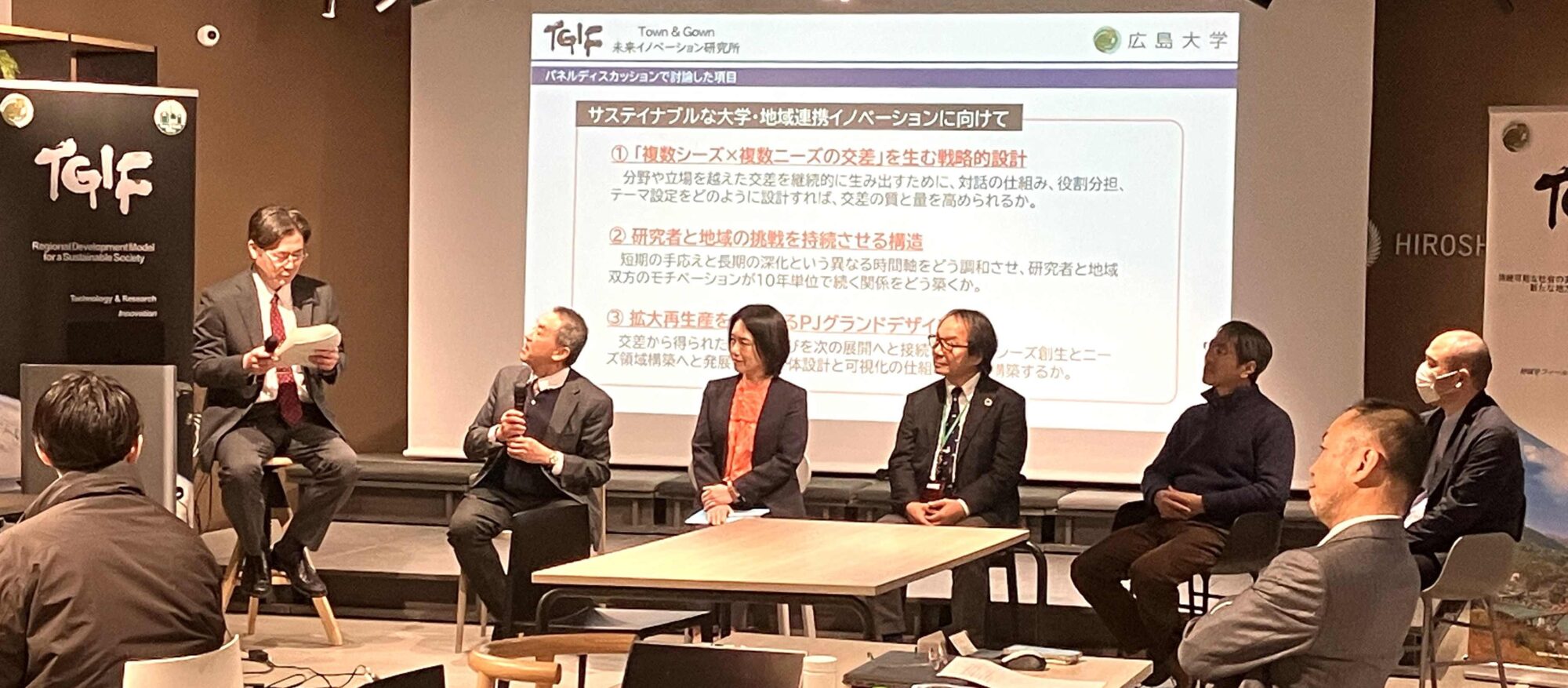
On March 2, 2026, the 16th TGIF Seminar—the final session of this fiscal year—was held under the title ‘TGIF Results Presentation 2025: Taking the Next Step Toward Social Implementation through Town & Gown × COMMON’.
In this seminar, faculty members involved in the various TGIF divisions and the COMMON project presented research outcomes aimed at social implementation and addressing regional challenges under the Town & Gown initiative. Their reports covered a wide range of fields, and the session featured active discussions that looked ahead to future developments in the coming fiscal year and beyond.
Below is a digest of the presentations delivered during the seminar.
1. TGIF’s Role and Future Outlook within the Town & Gown Initiative: Director Onishi (TGIF)
Director Onishi provided an overview of TGIF’s role as a hub connecting the university’s research seeds with the needs of local government. He presented a theoretical model illustrating how reducing barriers to innovation—conceptualized as ‘friction energy’—can accelerate social implementation and regional development, and shared the direction for TGIF’s future activities.
2. Promoting DX and EBPM through the Reboot of the TGO App: Prof. Li (TGIF)
Prof. Li presented the potential for developing a smart‑city ecosystem through the reboot of the TGO app. He explained that, by obtaining users’ consent (opt‑in) for data provision and utilizing citizen data to deliver personalized services, the app could serve as a foundation for evidence‑based policy making (EBPM). This approach, he noted, holds significant promise for building a data‑driven policy infrastructure.
3. Building a Circular and Symbiotic Community through Agrivoltaics: Prof. Komoto (TGIF)
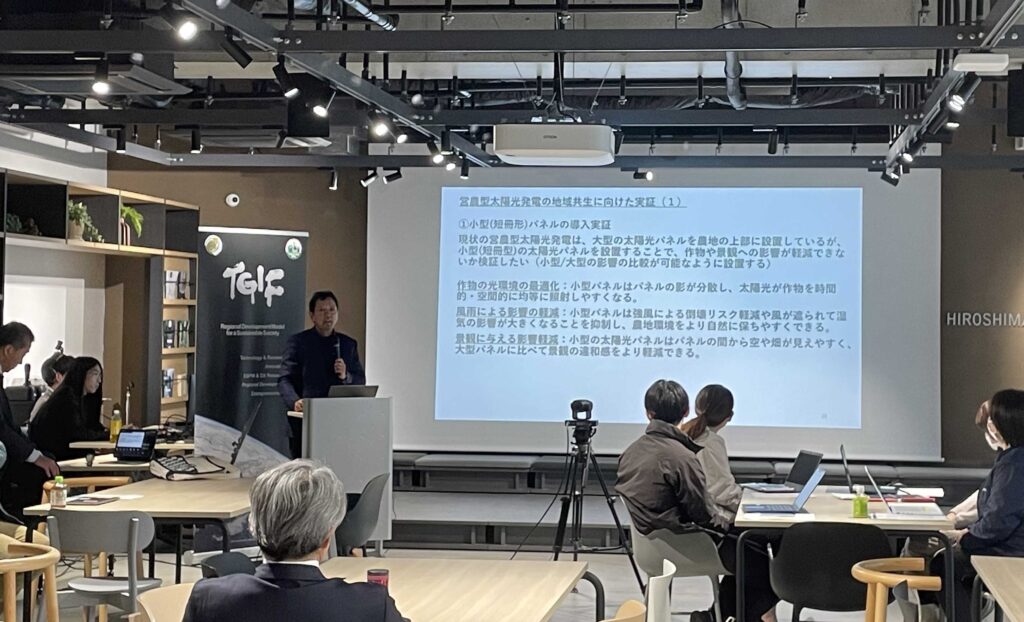
Prof. Komoto reported on the use of agrivoltaics (solar sharing) as an approach that simultaneously addresses the issue of abandoned farmland in hilly and mountainous areas and promotes the introduction of renewable energy. He presented a new community‑symbiotic model that incorporates measures such as the use of small solar panels designed to minimize visual impact and withstand strong winds, as well as the combined implementation of organic farming.
4. Social Support, Sleep, and Oral Health among Older Adults in the Community: Prof. Naito
Prof. Naito introduced an international comparative study aimed at preventing frailty in an ultra‑aged society by examining the interrelationships among social support, sleep habits, and oral health. He also reported on the progress of data collection conducted at community gathering places within Higashihiroshima and discussed future prospects for food‑related support through multidisciplinary collaboration.
5. Monitoring Wildlife and Mitigating Human–Wildlife Conflict through Environmental DNA: Prof. Nishibori
Prof. Nishibori presented cutting‑edge sensing technology that uses environmental DNA collected from the air to identify the presence of wildlife such as bears and deer. By visualizing otherwise invisible DNA and estimating population numbers, this approach offers a promising method for developing more effective strategies to mitigate human–wildlife conflict.
6. Enhancing the Efficiency of Emergency Response through Smart Mobility: Prof. Takaki
Prof. Takaki reported the results of a pilot study that explored the use of electric kick scooters in narrow or unpaved areas where ambulances cannot enter. The findings demonstrated that deploying electric kick scooters can shorten the time for emergency personnel to reach the scene and help reduce physical fatigue. He also outlined the challenges that must be addressed for future social implementation.
7. The ‘COMMON Project’ Connecting the City and the University: Mr. Yamashita
Mr. Yamashita, a staff member seconded from the Higashihiroshima City Government, explained the structure of the ‘COMMON Project,’ which systematically matches municipal challenges with academic research at the university. He introduced a stepwise certification scheme that progresses from initial support to full joint projects, providing a framework that steadily leads to the resolution of local issues.
Summary: Panel Discussion
In the panel discussion moderated by Prof. Ishii, participants examined how to bridge the ‘time‑scale gap’ between local governments, which often seek short‑term outcomes, and universities, which prioritize long‑term research. The discussion highlighted a shared recognition that fostering sustainable innovation requires establishing support systems that can operate ‘steadily and over the long term,’ as well as cultivating the next generation of students and young professionals who will carry these initiatives forward.
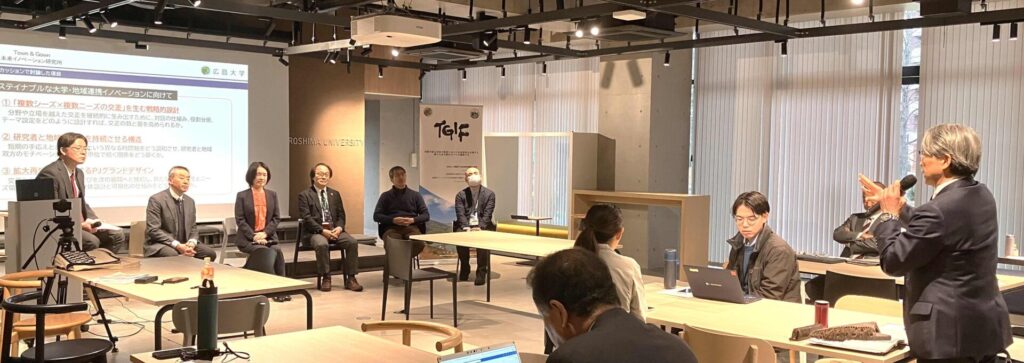
Front row, from left (titles omitted):
Dr. Ishii – Director, TGIF Innovation Creation Division
Dr. Onishi – Director, Hiroshima University TGIF
Prof. Naito – Graduate School of Biomedical and Health Sciences
Prof. Nishibori – Graduate School of Integrated Sciences for Life / Institute for Smart Society Practice
Prof. Takaki – Graduate School of Advanced Science and Engineering
Mr. Yamashita – TGO Research Associate, Higashihiroshima City & Hiroshima University
About TGIF Seminar
The TGIF seminar drives to engage with all participants to understand the challenges and identify new research and business opportunities through collaborations. The outcomes could lead to further research funding or new business opportunities and strengthening cross-sector networks. By working with multidisciplinary academics and industry partners, we aim to contribute to regional and national development as a successful example in Japan, specifically in the area of ‘carbon neutral, smart city and campus SDGs.